
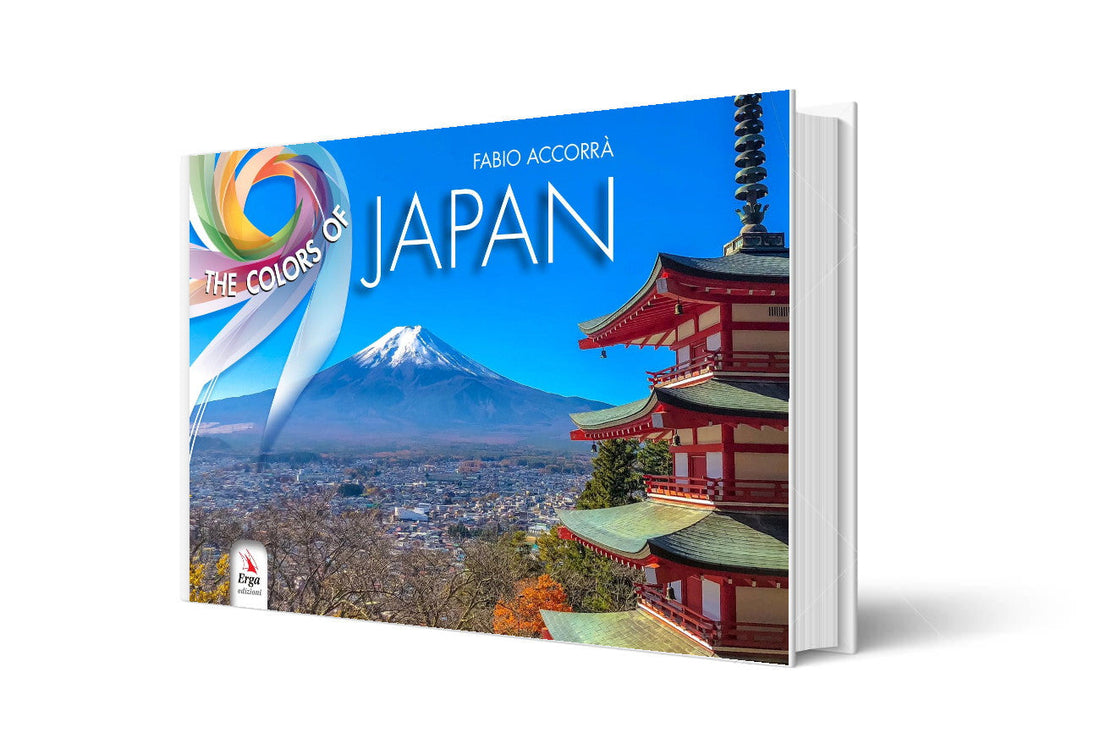
The Colors of Japan, the photographic book
Genoa - Travel 4.0, that of augmented reality and real-time video, rediscovers the artistic and documentary value of fine art photography, speaking essentially through the emotion of the image and color. This is the attempt achieved by Fabio Accorrà in the recently released book "The Colors of Japan." The Genoa-born author, a project manager by day and blogger by night, combines a pragmatic soul with an exquisitely artistic one, in a play of opposites that is also evident in the approach of his works.

The volume is color-coded through the various stops on the journey he and his wife took: Fuji, Hitachi, Tokyo and Osaka, Nikko, Hakone, Hiroshima, Miyajima, Himeji, Kyoto, Nara, Kanazawa, and Shirakawago. "Over 3,600 photographs were collected, making it difficult to choose," explained Fabio Accorrà, "especially when trying to provide an innovative interpretation of each of the sites explored. It's not easy, because writing is a complex process that spans from conception to research, all the way to choosing the publisher—Erga in this case—to reach a complete agreement, essentially with carte blanche, as they say ."

The simplest color to match is the white "shiro," the color of the Mount Fuji hat, the symbol of the country, but they all reveal a feeling, as highlighted by journalist Bibi D'Oria in her introduction, and by travel expert and writer Pietro Tarallo's reflection, according to which "Japan is an excursus into a culture, in a different sociological form, in a mix of history and advancing innovation, especially in the figure of the young woman as opposed to the geisha."

In the collective imagination, at first glance, what strikes us is the black "kuro," the power and elegance of Tokyo and Osaka, with the darkness broken only by skyscrapers and illuminated advertising, or the poetic yellow of Nikko's foliage, a romantic, sometimes melancholic vision. Then there's the green "midori," from Japanese pesto to the gardens of Kanazawa with their ponds guarding enchanted carp and a hidden tradition, jealously passed down from one generation to the next.

from THE 19TH CENTURY